

The Pressure Paradox: Why ALL that Grip is Failing You
0 comments
186
by Christopher Bean
This post first appeared on FaceBook
Just wrapped up a virtual coaching session where a fairly pervasive issue came up and was mitigated. I often talk about the “CLP” concept (Contact, Leverage, Pressure) as the pillars of a solid handgun grip.
But today, I want to focus on the most misunderstood element: Pressure.
There is a massive misconception about what effective pressure looks like. I see it every day with clients both virtually and on the range—shooters “locking out” to the point of failure, thinking more tension equals more control, where anatomically unsound mechanics result in erratic and injurious outcomes. We’re we ask ligaments and joints to do the work muscles were designed to do. Yet, when the results dont appear to be any better. Our answer is always MORE tension. I personally dont subscribe to this.
1. The 50% Rule: Why I Don’t Max Out My Strong Hand
I’ve tested my grip strength with a dynamometer; my dominant hand generates on average 118 lbs of force. But when I shoot, I only input about 66 lbs. Roughly half.
– Muscle Synergists & Irradiation: When you max out the extrinsic flexors of the hand, “tension bleed” occurs. Physiologically, it is incredibly difficult to maintain a maximum isometric contraction in the palm and digits while simultaneously demanding high-speed, isolated movement from the index finger. We are simply not built this way.
-The Result: If I grip at 100%, my trigger finger becomes “heavy” and sluggish. By backing off to to roughly 50%, I maintain structural integrity while keeping the Flexor Digitorum Profundus (the muscle moving the trigger finger) free to work independently. This also reduces sympathetic muscle triggering in the belly of the forearm. The dreaded, right left movement under trigger press.
2. The Support Side & The Hyperextension Trap
My support hand is capable of 113 lbs, and I input nearly all of it. This is where the stability comes from. However, I often see shooters hyperextending the elbows and wrists to “clamp” the gun. This is scientifically counter-productive:
-The Length-Tension Relationship: Muscles generate the most force when their sarcomeres are at an optimal mid-range length. According to the Length-Tension Curve (Gordon et al., 1966), as a joint is hyperextended, muscle fibers are overstretched, losing their ability to form cross-bridges and significantly decreasing force production.
– Wrist Instability: Hyperextending the wrist puts the joint in a “closed-packed” position that relies on bone-on-bone contact rather than muscular stabilization. This actually inhibits the Flexor Carpi Ulnaris and Radialis, making you LESS able to resist the snap of recoil.
3. The Recoil Myth: You are 8x Stronger Than Your Gun
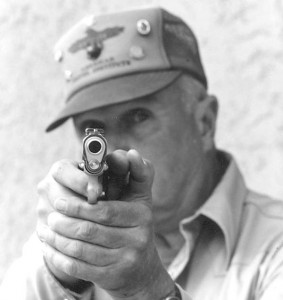
We over-grip because we fundamentally overestimate the “power” of the handgun. The reciprocating mass of a standard 9mm slide generates roughly 17 to 20 lbs of peak force as it moves rearward.
-The Reality Check: Most shooters, barring injury, are capable of generating 3 to 8 times the force that the gun actually exerts.
-The “Why”: We “crush” the gun because our brains interpret the sudden impulse of recoil as a threat. We respond with white-knuckle tension, but we are effectively bringing a sledgehammer to a thumbtack fight.
4. Why “Flat” is Overrated
There is a modern obsession with “shooting flat”—making the gun look motionless in slow-motion video. But reciprocal movement isn’t a bad thing. In fact, a gun that “tracks” (moves up and then returns) is often faster than a gun being fought into stillness. The very overexertion people chase equates to slower work. Imagine, walking with a ruck the wieght of your body versus walking with a ruck that wieghs 1 tenth of that. All the structural and muscular tension to perform option 1 has NO applicable relationship to the performance of option 2.
-Repeatability over Suppression: Your goal isn’t to stop the muzzle from rising; it’s to ensure it stabilizes and returns to the exact same zero point every time.
-Predictability: When you allow your arms to act as a suspension system rather than a brittle, locked-out vise, the gun returns to your line of sight more predictably. Predictability equals belief, belief results in speed.
Stop trying to lock the gun into submission. Focus on the return, not the rise. When you explore pressure, critically. One finds what’s actually needed not what’s imagined. Working with physics instead of doing your best to oppose it results in better performance, avoidance of injury and a simply more enjoyable progression path. Instead of using every ounce of strength you have. Be more inquisitive of the how’s, where’s and why’s of applying pressure.
References:
-Gordon, A. M., Huxley, A. F., & Julian, F. J. (1966). The variation in isometric tension with sarcomere length in vertebrate muscle fibers. The Journal of Physiology.
-Lieber, R. L., & Friden, J. (2000). Functional architecture of the human arm. Clinical Orthopaedics and Related Research.
-Hager-Ross, C., & Schieber, M. H. (2000). Quantifying the independence of individual finger movements. Journal of Neuroscience