

Police Stress Drills: Build Decisions Not Scars
0 comments
26
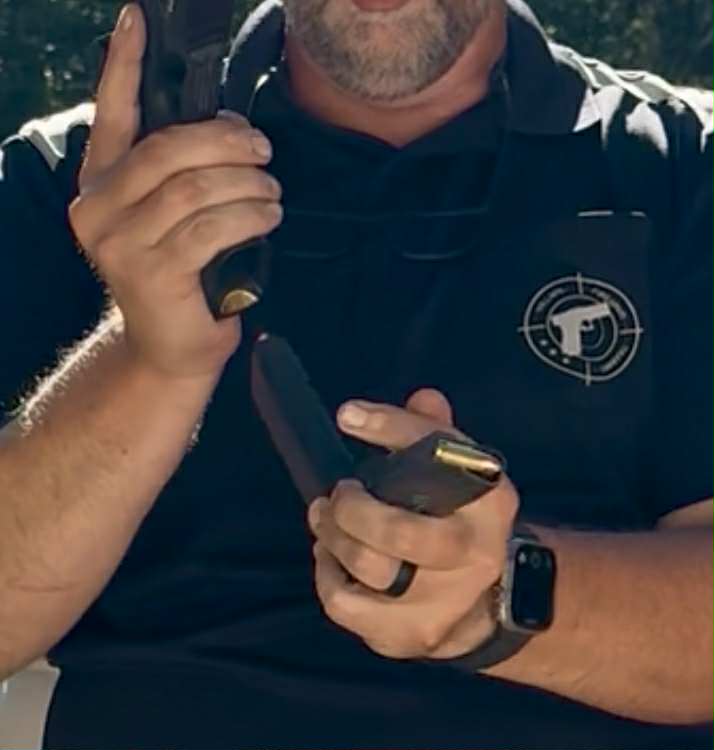
Here is a live-fire progression built for cops, not competitors — designed to build decisions under stress without baking in scars.
Operating Principles
1. Foundation -> Automaticity -> Judgment.** Don’t add stress until the gun handling is automatic. Stress on top of a shaky draw/reload just trains panic.
2. The 70% Rule – Force Science.** Keep the shooter succeeding ∼70% of the time. If they’re at 100%, it’s too easy. If they’re at 40%, you’re just flooding them and creating learned helplessness. Adjust difficulty to stay in that 70% window.
3. No Predictable Patterns.** Training scars come from predictable ranges: always 2 rounds, always to slide lock, always shoot the paper when it turns. Vary everything.
Five Levels of Progression
Level 1: Baseline Automaticity – No Decisions Yet**
Goal: Prove gun handling holds without thinking.
– Cold: Draw to 1 accurate hit at 7y from holster, on a B-8. Par 1.5 sec. No extra commands.
– Add motor load: 10 air squats or 20y sprint, then same drill, 90% of baseline score required.
– Scars to avoid: Don’t start timing cognitive load until they can do this clean 8/10 times.
Level 2: Cognitive Load + Shooting**
Goal: Shoot while the brain is busy.
– Drill: “Math + Marksmanship” – Partner calls 2 numbers (e.g., “7 + 4”). Shooter must answer while drawing and putting 1 round in the A-zone. Answer wrong = no-shoot penalty even if hit is good.
– Drill: Color/number memory. Show 3 colors for 3 seconds. Turn target. Shooter must recall in order, then engage 1-3 targets based on count.
– Key: Load is *before* and *during* the decision, not after.
Level 3: Shoot / No-Shoot Cueing**
Goal: Break the stimulus-response of “beep = shoot.”
This is where most ranges create scars.
Use realistic, changing cues — not just target color:
– Hands, not targets. Use photo-real targets or a partner with paddle. Gun / cell phone / badge / empty hands.
– Incongruent cues. “Hands up!” where one is a shoot, one is no-shoot. You want them to look at hands/weapons, not listen for a word.
– **Rule: Never more than 60% shoot in a block.** If you run 10 reps, 4 should be no-shoot. If they always shoot, you’re training them to shoot.
Drill: The 3-Second Problem
Set 2 targets at 5y. On turn, one presents threat (gun/knife), one presents no-threat (phone). You have 3 seconds to decide + 1 accurate round if needed. If you shoot a no-shoot, immediate reset and verbal articulation: “What did you see?”
Level 4: Layered Stress – The Decision Stack**
Goal: Combine physiological stress + cognitive load + judgment.
Example Block – 70% Success Tuned:
1. Sprint 25y to cover, 4-count breathing to get gun up
2. Partner gives radio traffic: “Suspect: Red hat, blue shirt, gun in right hand”
3. Three targets turn: Red hat/blue shirt/gun = shoot, other two are decoys. Only one round per threat.
4. After engagement: Scan, top off mag *on your own* — do NOT train to slide lock, do NOT train to always reload. Sometimes you cue “top off,” sometimes you don’t.
Run 5 times, move the threat position every time.
Level 5: Articulation Under Stress
Goal: If you can’t say why, you didn’t decide — you reacted.
Immediately after Level 4, before they unload: “What was your threat cue? Why no-shoot on target 2?”
This builds the prefrontal cortex back online after the sympathetic spike. It’s the anti-scar. Bad training ends with “good shooting.” Good training ends with “good decision.”
Scars Checklist — Audit Your Drills
Stop doing this:
– [ ] Same round count every string (always 2)
– [ ] Always shooting to slide lock
– [ ] Always re-holstering on command
– [ ] Standing still on a flat range for all decision drills
– [ ] Instructor always says “gun!” before a shoot target
Start doing this:
– [ ] Randomize round count, reload timing, and holster cue
– [ ] 30-40% no-shoots in every decision block
– [ ] Variable start positions: seated, grounded, around cover
– [ ] Force a verbalization before holstering
– [ ] Keep a log: time, accuracy, *and* decision accuracy. If decision accuracy drops below 70%, reduce load. If it’s 95%+, add load.
Here’s your 4-week, 2x/week progression. 150 rounds per session max, built to stay in that 70% window.
You need: B-8s, 3x photo-realistic threat / no-threat paddles or targets, shot timer, cover barrel / barricade.
### WEEK 1: Automaticity Audit
**Session 1A – Baseline**
– Warmup 20rds: Draw to 1 at 7y, par 1.5 – goal 8/10 A-zone
– Main 60rds: Sprint 20y + 1 round. Then Math + Marksmanship (partner gives addition problem, must answer *while* shooting 1 round). Track accuracy + answer accuracy.
– No-Shoot Intro 40rds: 10 reps, 5 shoot / 5 no-shoot. Gun vs phone paddle. 3 sec limit.
– Debrief: What was your cue?
**Session 1B – Load It**
– 30rds: Same as 1A but from seated and kneeling behind cover
– 70rds: Color memory – show 3 colors for 3 sec, recall, then 1-3 rounds based on number of reds you saw. Forces working memory.
– Scar Fix: Random reloads. I will call “top off” on 50% of strings only. You decide other times. Never to slide lock.
### WEEK 2: Decision Speed
**Session 2A – Hands, Not Targets**
– 80rds: 3 targets at 5y. Radio description: “Red hat, gun in right hand.” One threat, two decoys. Change threat each rep. 40% of reps are ALL no-shoot – all decoys.
– 40rds: Incongruent command drill – partner yells “Don’t shoot!” on a shoot target and “Shoot him!” on a no-shoot. You must go off hands.
**Session 2B – Stack**
– 100rds: The Decision Stack x 10
1. 25y sprint to cover
2. Radio traffic + paddle presentation
3. 1 round if threat
4. Immediate articulation: “Saw X, so I did Y”
– Goal: 7/10 correct decisions. If >8/10, shorten time to 2 sec. If <6/10, add 1 sec.
### WEEK 3: Stress Inoculation
**Session 3A – Physiological**
– 20rds: 30 sec max effort bike/burpees, then draw to 1 – learn your wobble zone
– 80rds: Same + decision. HR up + cognitive math + shoot/no-shoot. This is your hardest day. Expect accuracy to dip 15% – that’s normal.
**Session 3B – Ambiguity**
– 90rds: Low-light or turning targets if you have them. Threat/no-threat with subtle cues – waistband gun vs cell phone in waistband. 2 rounds max per rep.
– Scar Fix: No consistent holster cue. Sometimes you stay at low ready, sometimes scan and holster on your own.
### WEEK 4: Validation
**Session 4A – The Test**
– 50rds cold: Run Week 1 baseline again. You should be same speed, *more* accurate under load.
– 70rds: Force-on-paper scenario – 3 positions, use cover, 2 threats mixed with 2 no-shoots, must move between positions. 1-2 rounds per threat only.
**Session 4B – Coach The Coach**
– 60rds: You run a shooter through the stack and *you* call the cues. Best way to find your own training scars is watching others hit them.
– Final debrief for all: 3 questions – What did you see? Why was it a threat/no-threat? What would you do differently with 1 more second?