

Polite Society Industries Silencers: TRIPASS CORE TECHNOLOGY™
I want to know how things work. The market is flooded with suppressors, old and new. Polite Society Industries Silencers have set them selves apart with innovative technology which changes the way they work. They may not be the cheapest models, but I would argue that they are among the best at any price. If you have a minute to read this, you will know why. Pressed for time, look at the cool pictures.
The information below is taken directly from their website with permission. It is very well written and explains complex topics simply. I can’t do it better.
TRIPASS CORE TECHNOLOGY™
Three Paths. Three Chambers. One Piece of Metal.

Why A Gunshot Is Loud
Burning powder makes gas — a great deal of it, very hot, under enormous pressure. When the bullet clears the muzzle, that gas follows it out and hits still air faster than the air can move aside. The collision is a shock wave. The shock wave is the boom.
A silencer’s job is to get between those two things: give the gas somewhere to expand, time to cool, and room to slow down, so it reaches the atmosphere as a push instead of a punch.
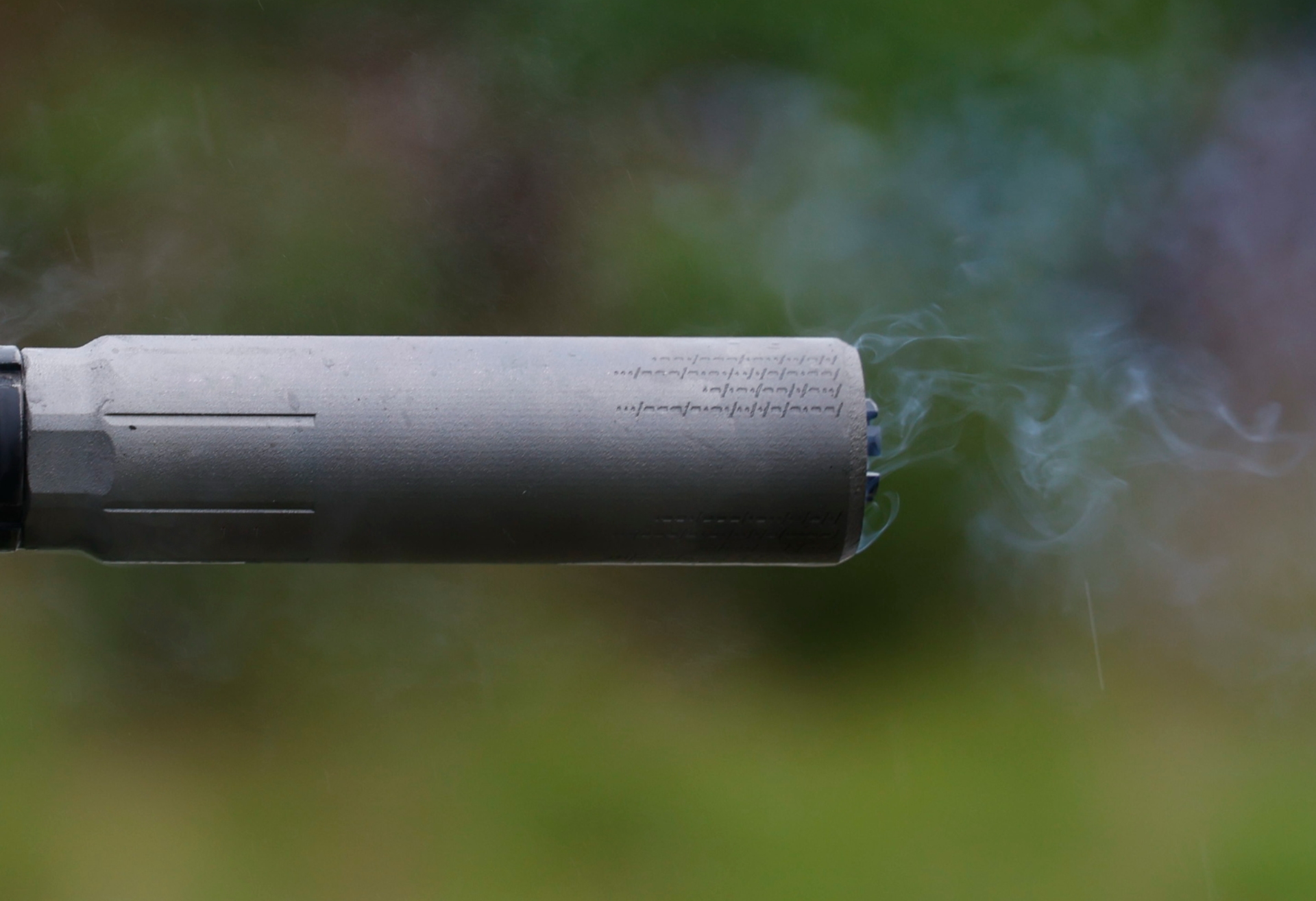
It Comes Down To Gas Retention
Everything else is detail. The longer a silencer holds gas before letting it go, the more heat and pressure it sheds on the way out, and the gentler the exit. Internal volume helps. Path length helps more. What you do with the gas while you have it decides the rest.
The conventional approach is a stack of baffles — cones in series that catch gas and turn it back on itself. It works, and it has worked for ninety years. But it’s one route through the silencer, and how much you can complicate that route is bounded by what a cutting tool can reach and by how many separate parts you’re willing to align.
Three Paths, Not One
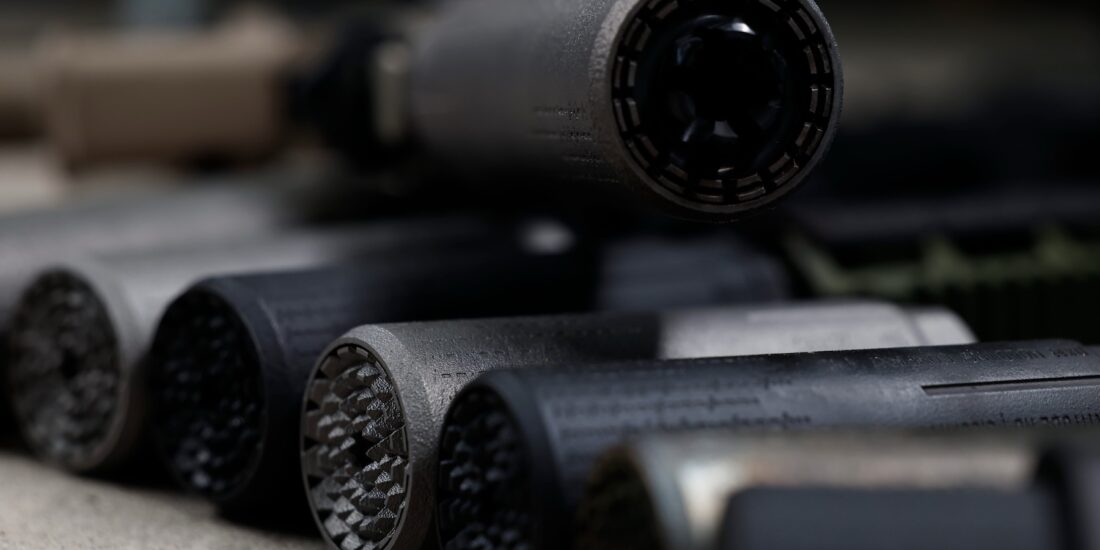
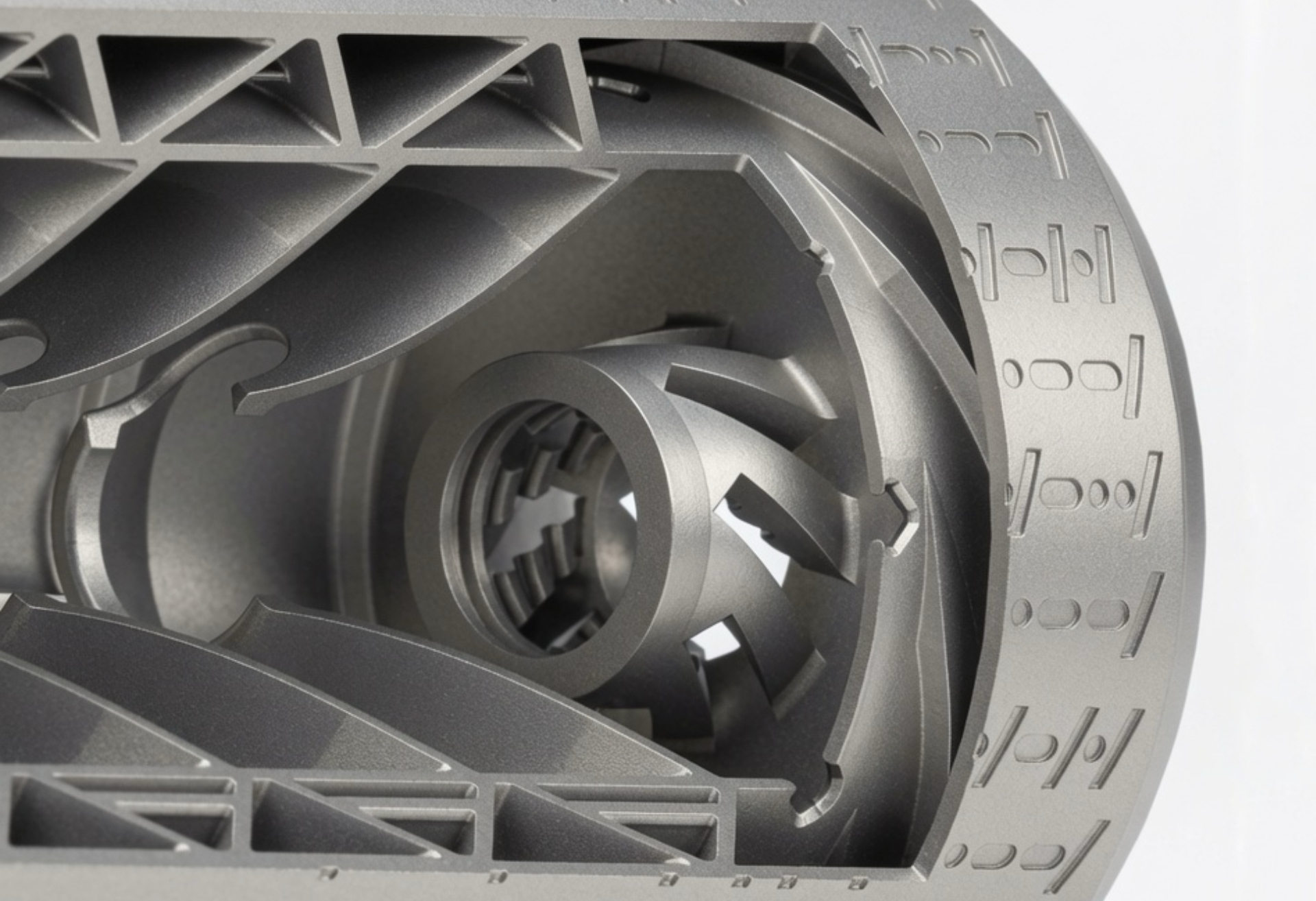
Tripass Core Technology™ splits the gas the moment it enters. A central bore carries the bullet and the column of gas immediately behind it. Two helical channels wind around that bore, drawing gas off and sending it on a longer, slower route through the body.
Those three paths feed a series of expansion and mixing chambers. Inside each, flow is turned back against itself and against gas arriving from the other two paths — fast, hot gas meeting slower, cooler gas and trading energy at every meeting. Counter-rotating blades keep it moving instead of letting it find a straight line to the exit. The result is a much longer journey inside a body of the same length.
Why The Walls Aren’t Smooth
ACOUSTIC GOLFBALL DIMPLING™
One surface treatment. Three results.
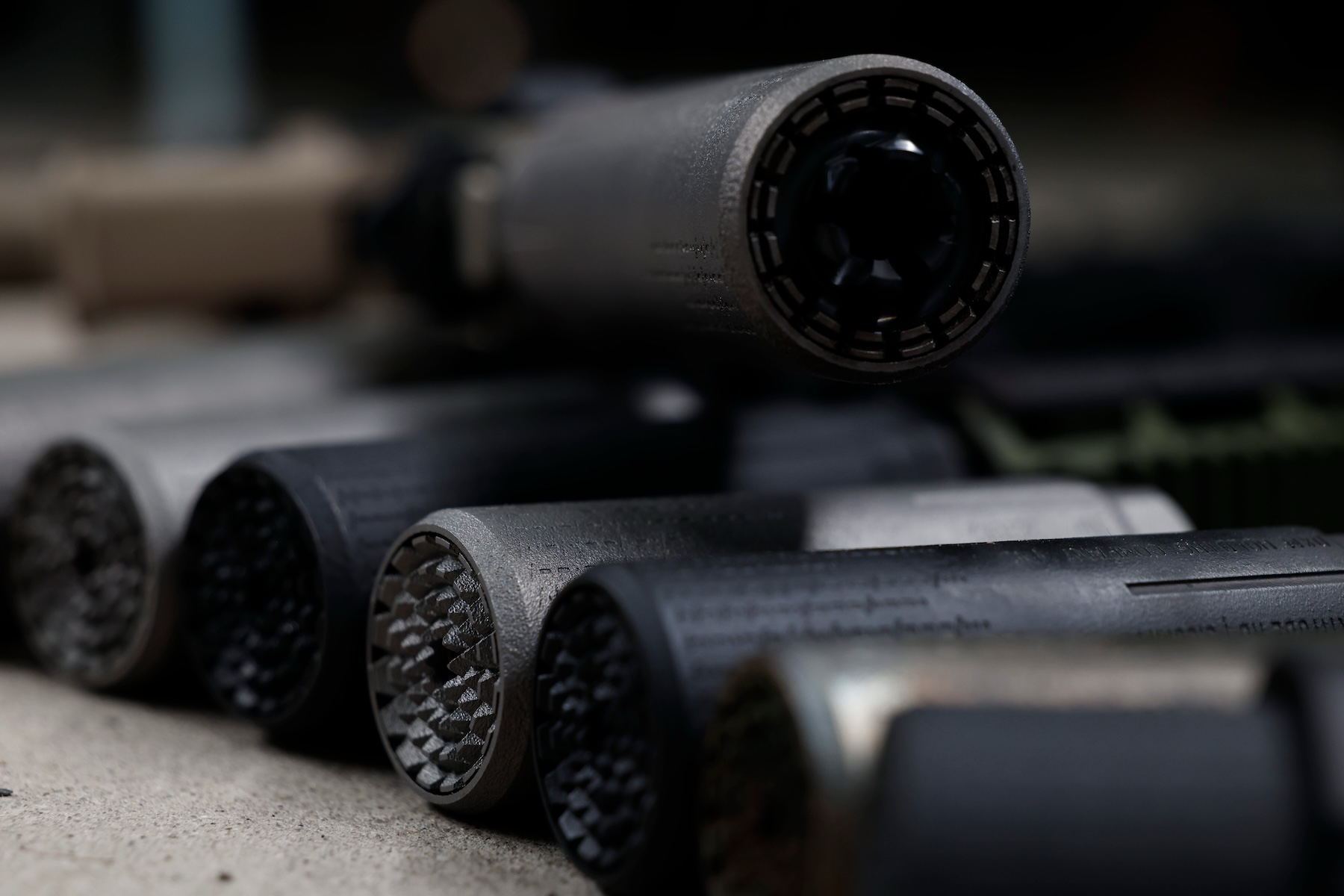
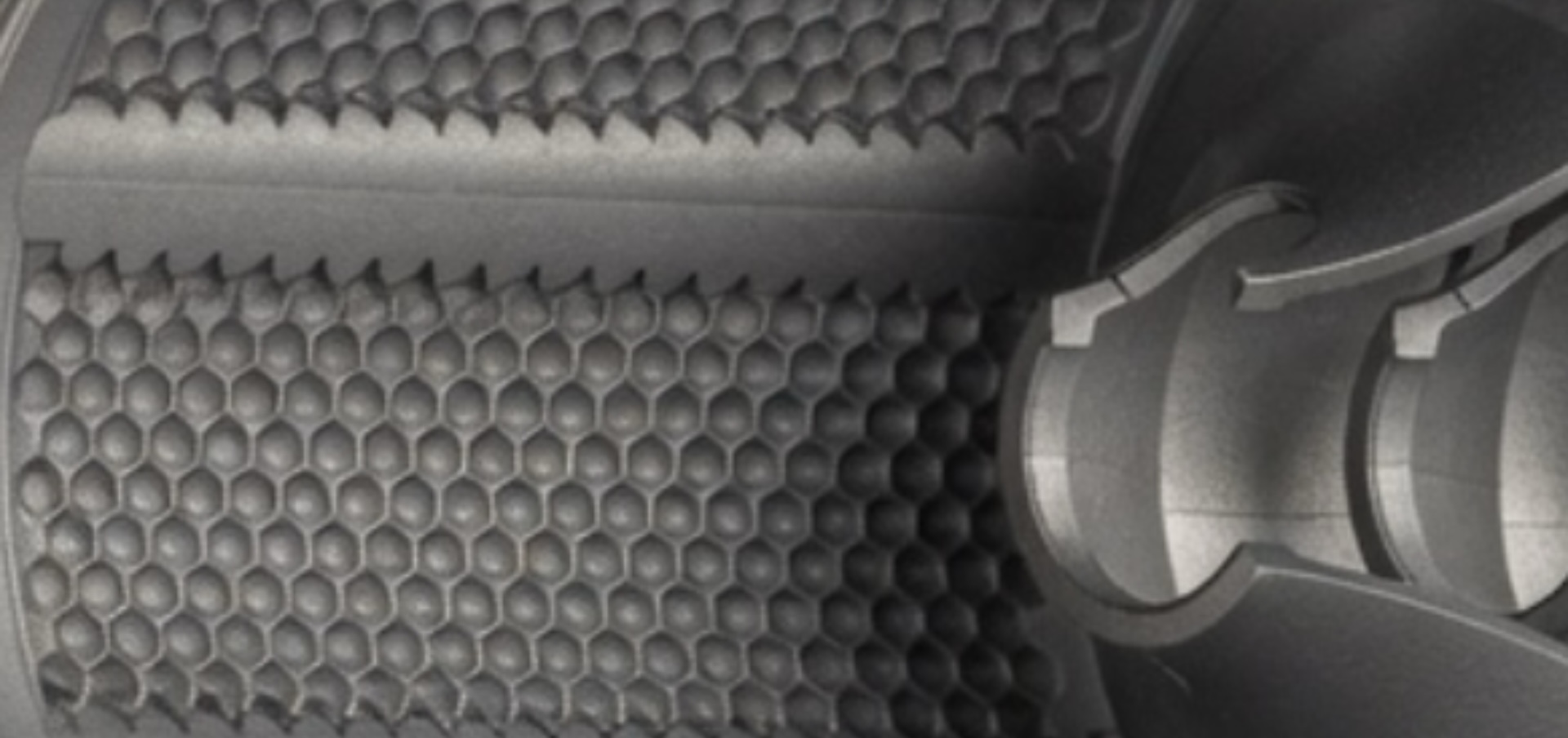
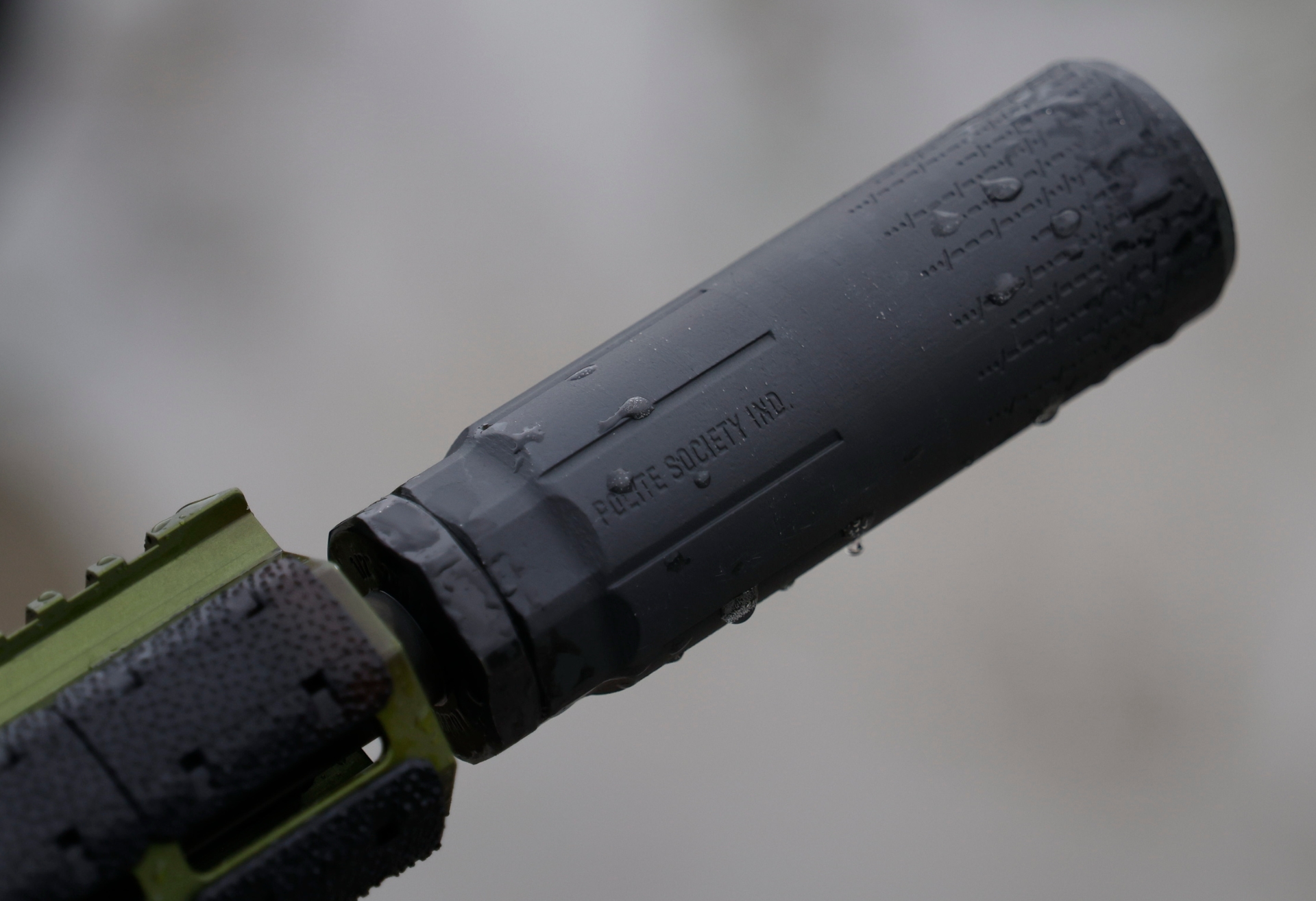
Every internal surface of a centerfire Polite Society silencer is dimpled rather than smooth, and it isn’t decoration. It does three things: it adds internal volume without adding length, it drops the tone of the shot, and it makes the silencer stronger.
The reason nobody did it before is that nobody could. Dimpled walls are unreachable by any cutting tool, so for ninety years the inside of a silencer was smooth by default rather than by decision. Ours are formed layer by layer instead of cut, which turned the surface into something you get to choose.
Why a golf ball is dimpled
A smooth ball moving through air drags a thin layer of still air along with it. That layer separates cleanly off the back, leaving a wide low-pressure wake that pulls backward on the ball.
Dimples break the layer up. The air closest to the surface becomes turbulent, clings further around the curve before it separates, and leaves a narrower wake behind it. A dimpled ball flies roughly twice as far as a smooth one, hit identically.
The lesson isn’t about flight. It’s that a textured surface controls the thin layer of gas touching it — and that control is worth far more than the smoothness it gives up.
Inside a silencer, that control does three separate things.
One: volume without length
A silencer is a container for hot gas. The more room it has to hold that gas — and the longer it holds it — the more energy it takes out before letting it go.
The obvious way to get more room is to make the silencer longer. That’s also the worst way, because length at the muzzle is the thing every shooter is trying to avoid.
Dimpling buys the room instead of the length. A dimpled wall occupies the same footprint as a smooth one while enclosing meaningfully more internal volume, because every dimple is a small pocket of space that a flat wall simply doesn’t have. Across every internal surface it adds up to volume that would otherwise cost roughly another inch and a half of length — which, on a silencer that already measures five inches, is most of the reason it measures five inches.
That’s not a rounding error. That’s the difference between a silencer you’re happy to leave on the rifle and one you take off.
The texture works on the gas as well as the space. Gas moving across a smooth wall slides. Gas moving across a dimpled wall tumbles — it catches, curls, and takes a longer path to cross the same distance. Slower gas spends longer inside, and gas that spends longer inside gives up more.
And it steers. The disruption is deliberately strongest in the expansion chamber, where it pushes the hot gas outward — away from the bore path and into the outer helical channels, which is exactly where you want it. Gas kept off the bore line is gas that isn’t following the bullet out.
Two: it changes the tone, not just the volume
A decibel figure tells you how loud. It has nothing to say about what it sounds like, and to the person behind the rifle that difference lands as hard as the number does.
Every silencer is a chamber, and every chamber has an acoustic character — a resonance set by its size, its shape, and the surfaces the sound reflects off. A smooth-walled chamber reflects cleanly and returns a sharper, higher, harder report. Dimpled walls scatter those reflections instead of returning them, and what comes back is markedly lower and deeper.
A deep report reads as distant and contained. A sharp one reads as a gunshot, whatever it measures. Both things are true at once, and only one of them fits on a spec sheet.
Three: it makes the silencer stronger
The third thing is structural, and it runs opposite to what you’d expect from adding texture.
A dimpled surface is stiffer than a flat one of the same thickness. The geometry itself carries load — the same principle that makes corrugated material stronger than the sheet it was formed from. Which means the wall can be thinner and still be strong enough.
That’s the same logic the baffle geometry follows: put metal only where the part actually needs it, and take it out everywhere else. Formed layer by layer, thickness becomes a variable you set surface by surface rather than a constant you’re stuck with. The same is true of the walls, which is why a titanium one weighs what it does.
None of this shows up on a spec sheet. A dimple has no line item. It’s the sort of thing you do because the part is better for it, not because it sells one more silencer.
It’s on every one of them
The Temperance at four inches and the Verdict 7.62 at six and a half get the same treatment, for different reasons — on the small one it’s the volume that matters, since there’s no length to spare anywhere; on the large one it’s the tone. On the Huckleberry it’s the reason a silencer built to run several calibers doesn’t sound like a compromise on any of them.
Why smooth was never a choice
Worth being clear about, because it gets assumed backwards. Conventional baffles are smooth because a lathe leaves them smooth, not because anyone determined smooth was better.
Every internal surface of a machined silencer is the record of a cutting tool passing over it. The tool leaves a finish; the finish is what you get. Nobody chose it — it was the residue of the process.
A tool has to reach the surface it’s working and then get back out, and the inside walls of a silencer are among the least reachable surfaces in a manufactured object. That constraint is the reason every conventional silencer is a stack of cones and smooth tubes.
Once the process changes, the surface becomes a decision.
Doesn’t it trap fouling?
It’s the first question anyone technical asks, and it deserves a straight answer.
Centerfire rifle silencers are largely self-cleaning: the pressures and temperatures involved consume most of what would otherwise accumulate, and gas moving through at those velocities scours the surfaces it passes. The texture is also shallow — dimples, not pockets. There’s nowhere for material to sit and hide.
Rimfire is the exception, and it’s the exception on every silencer ever made, textured or not. Rimfire ammunition deposits lead and wax at a rate centerfire never approaches. That’s a property of the ammunition, not of the wall it lands on.
The Last Thing the Gas Touches
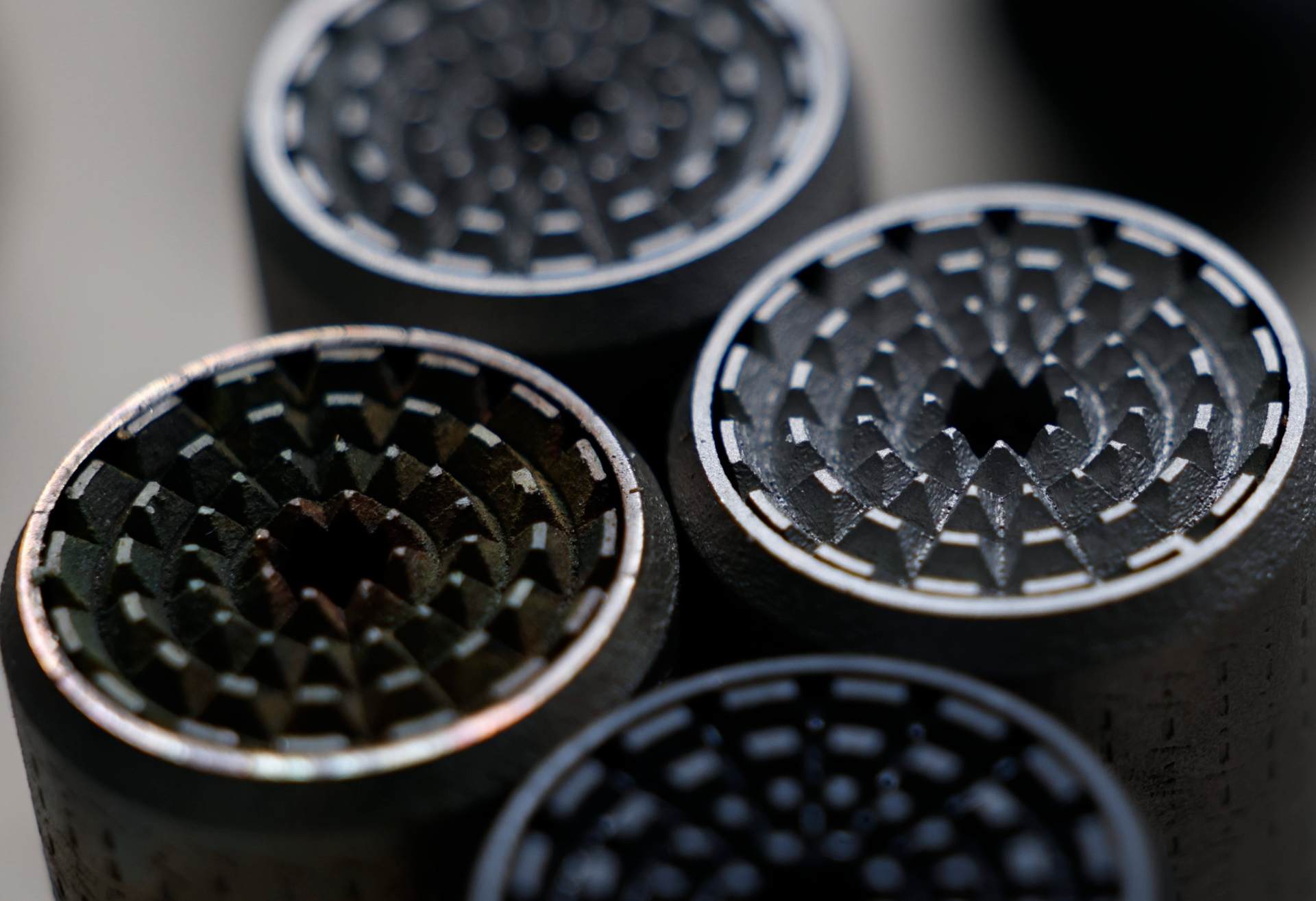
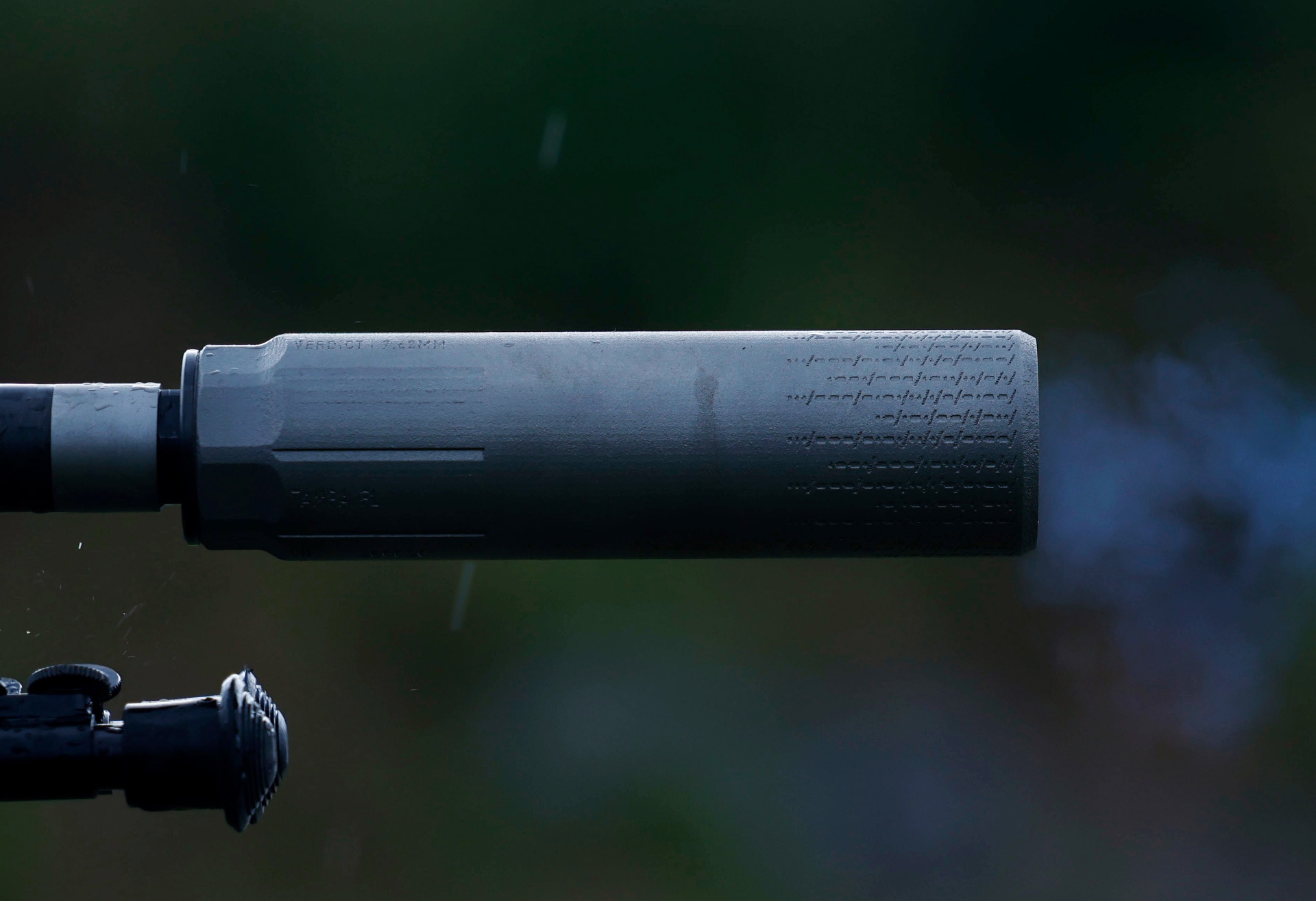
The Jet-Turbine Diffuser Endcap™ doesn’t simply let gas out of a hole. It disperses and directs the release, spreading it rather than concentrating it — which cuts flash and muzzle signature at the point where both are worst, and sends less gas back into the action while it’s at it. The shape is borrowed from a jet engine’s exhaust, and on the Huckleberry it threads off so the aperture can change with the host.
Helical channels wrapped around a central bore, feeding chambers with blades inside them, is not a shape you can cut. It isn’t a shape you can assemble either, without introducing a joint at every transition and a tolerance error at every joint.
Every Polite Society silencer is formed as a single continuous piece by laser powder bed fusion. The geometry isn’t a feature we added to the manufacturing method — it’s the reason we use it. How that’s done →
What It Adds Up To
Quieter: More of the gas’s energy is spent inside the silencer instead of in the air beside your head.
Less Flash: Cooler gas, released deliberately, has less to burn on the way out.
Less Gas in Your Face: Gas that takes the long way forward is gas that isn’t backing up toward you.
Cooler Running: Heat shed across three paths and three chambers is heat that isn’t concentrated in one place.
The Part Nobody Tells You
A silencer works on the muzzle blast. It does not work on the bullet.
Anything travelling faster than sound drags a small sonic boom along behind it, and that crack happens downrange — after the bullet has left, well beyond anything a silencer can reach. No design changes it, ours included. It’s why the same silencer sounds like a different instrument with subsonic ammunition, and why rimfire sounds like a different category altogether.
We’d rather tell you that than have you find out at the range.
Titanium or Inconel 625
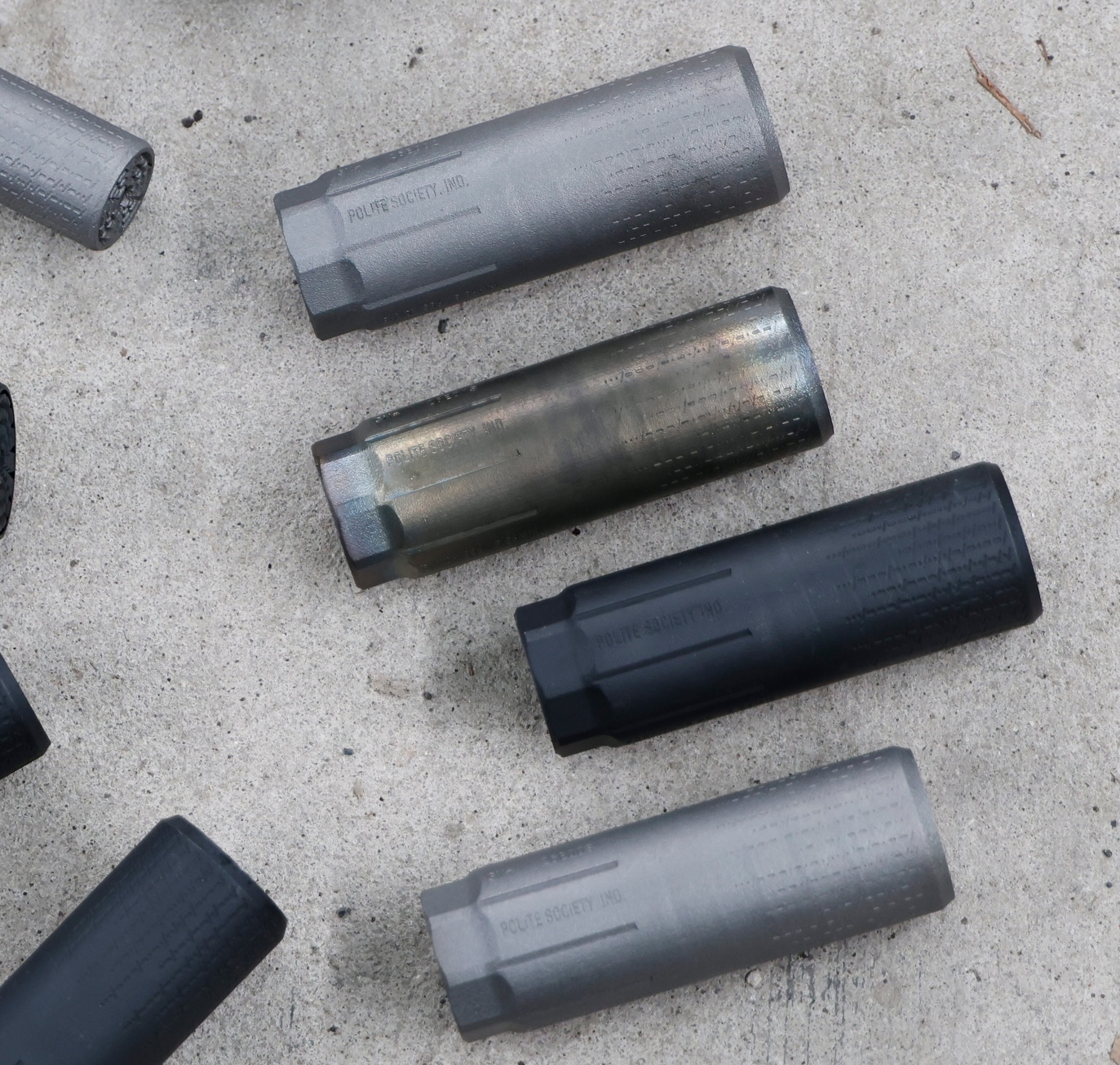
The core geometry is identical in both — same three paths, same chambers, same dimpled walls. You aren’t choosing between a good silencer and a better one, but between two metals. On the Fortitude 5.56 and the Verdict 7.62, the choice is yours.
Grade-5 Titanium (6Al-4V) is the one you carry. Roughly half the density of a nickel superalloy — our 5.56 runs 6.40 oz. against 11.50 oz. in Inconel 625. Five ounces at the muzzle changes how a rifle points and how it feels late in the day. Type-2 hard-coat anodized, and equal to anything an ordinary day asks of it.
Inconel 625 is the one you work. A nickel-chromium superalloy from the family used in the hot sections of jet engines, it holds strength where titanium begins to give ground. Built for long strings and a barrel that gets genuinely hot. It ships finished in Cerakote — a ceramic coating that takes heat and abrasion without letting go.
Most people are well served by titanium. If you’re unsure, it’s titanium — and if you’d rather not take that on faith, here’s what each metal actually is, and how to tell which one you are.
Silence Takes the Long Way
“An armed society is a polite society.”— Robert A. Heinlein, Beyond This Horizon
ABOUT Polite Society in their own words:
Politeness isn’t a nicety. It’s a stance. It’s what a person does when they have every capacity to impose, and chooses not to.
Restraint isn’t weakness either. It’s the highest expression of power.
Which is why we think a silencer ought to be an ordinary thing to own. Shooting suppressed is the courteous way to shoot — at the range, hunting, competing, defending your home. It’s how everyone should be shooting, and most of the reasons they don’t are reasons we can do something about.
So that’s the job. Make the courteous choice the easy one.
How We Started
We’re industry veterans. Decades in this business between us, and long enough in to see what was coming: a market about to open up to people who’d been priced out of it for years.
So we set out to build silencers those people could actually buy. Good, solid, honestly priced. That was the whole brief.
But partway in, we found something we weren’t looking for. With additive manufacturing, a great design and a merely good one use the same metal, sometimes less. The same print time, sometimes less. They come off the same printer, on the same build plate. The only thing a great silencer costs more of is the design work — and design is paid once, up front, by us, and never again by you.
Which meant the brief had been too modest. So we spent longer at the front end. More design, more testing, more refining, because the only thing it cost was our own time.
It costs nothing more to make a great suppressor than a good one.
What we ended up with was not the good, solid silencer we set out to build. It was a line of premium silencers at the price we’d aimed at from the start — the kind you’d be glad to have on your rifle for how it works, not what it cost.
Once you know that, charging like it costs more isn’t just greedy. It’s rude.
In the United States. Designed in Tampa, Florida, by people who use what they design.
Powder fused one micro-layer at a time reaches geometries no mill or lathe can cut, at a strength and weight neither can match.
Which also means the core comes off the build plate as a single piece. Not a tube with baffles stacked and welded inside it, every seam a place for something to loosen, shift or fail. There is nothing in there to come apart.
The Guarantee
If it breaks, we fix it. If we can’t fix it, we replace it. If we can’t replace it, you get your money back.
But we want to stand behind more than the metal. For most of the last century, backing a silencer put the burden on the owner. A replacement is a new serialized item, so it meant a new registration, another two hundred dollars in transfer tax, and the wait that came with it.
Since January 1, 2026 the $200 federal transfer tax no longer applies to suppressors. The registration did not go away, and we won’t pretend otherwise — a replacement still means a Form 4 and a wait. But the part that cost you money just to receive what you were already owed is gone.
Buy once. We’re here as long as you own it.
Because a promise that costs you money to collect was never much of a promise.
The Guarantee covers the person who bought the silencer new, for as long as they own it. The claim process is a phone call or an email — there is no form. Read The Guarantee in full.
Used by permission from https://politesocietyind.com/